The Concept of Yin and Yang – The Yin and Yang Story and History
Yin and yang is one of the most recognised symbols on earth, two interlocking shapes, one dark, one light, each carrying a seed of the other. But the visual is only the surface. The philosophy it encodes reshaped how entire civilisations understood nature, medicine, the body, and the self. Here is the complete guide: where it came from, what yin and yang actually mean, and how the principle works in practice.
What Is the Yin Yang Symbol and What Does It Mean?
The yin yang symbol, known in Chinese as the taijitu (太極圖), meaning “diagram of supreme polarity”, represents the idea that all things exist as inseparable pairs of opposites. Not enemies. Complementary forces, each dependent on the other, each containing the seed of the other within it.
The small dot of white inside the dark half, and the dot of black inside the light half, is the key: no quality exists in absolute form. Darkness holds the seed of light. Rest holds the seed of activity. Every yin carries yang within it, and vice versa. The circle as a whole represents the totality of existence, not the victory of one side, but the dynamic interplay of both.
Bring balance into your practice
The Origins of Yin and Yang, Ancient Chinese Cosmology
The concept dates to at least the 3rd century BCE, when the cosmologist Zou Yan (鄒衍) formalised it within the Chinese school of Yinyang thought. Zou Yan integrated it with the Five Phases, fire, water, metal, wood, earth, arguing that all change in the natural world was governed by the shifting relationship between yin and yang forces.
The roots are older still. The earliest written form appears in the I Ching (Book of Changes), dating to the 9th century BCE or earlier. The I Ching uses broken (yin) and unbroken (yang) lines to form hexagrams representing every possible state of transformation.
By the Han dynasty (206 BCE – 220 CE), yin-yang thinking had entered Chinese medicine, astronomy, architecture, and statecraft. It reached Japan by 675 CE, carried by scholars and Buddhist monks. It spread across East and Southeast Asia embedded in craft, ceremony, and daily practice.
What Does Yin Represent?
Yin (陰) encompasses the receptive, inward, and cooling qualities of existence:
- Earth, water, and the moon
- Darkness, stillness, and rest
- The feminine principle, in the cosmological sense, not as a value judgment
- Cold, softness, and inward movement
- The valley, low, hollow, receiving
In traditional Chinese medicine, yin governs the organs that store, the liver, kidneys, heart, lungs, and spleen. A yin deficiency manifests as heat, dryness, and restlessness. Yin time of day is night; yin season is winter; yin foods cool and moisten.
What Does Yang Represent?
Yang (陽) is the counterpart, active, outward, warming:
- Heaven, fire, and the sun
- Light, activity, and expansion
- The masculine principle
- Warmth, hardness, and outward movement
- The mountain, high, solid, projecting
In Chinese medicine, yang governs the organs that transform and move, the stomach, gallbladder, small intestine, large intestine, and bladder. A yang excess manifests as inflammation, agitation, and heat. Yang time is noon; yang season is summer; yang foods warm and energise.
The Balance Principle, Why Neither Side Can Win
The central teaching of yin-yang philosophy is that neither force is superior, and that imbalance in either direction causes disruption. Too much yang: overheating, conflict, burnout. Too much yin: stagnation, cold, withdrawal from life.
This is why the Taoists (who emphasised yin, receptivity, and non-action) and the Confucianists (who centred yang, social order, and active virtue) were not simply in disagreement. Each described one side of a living whole.
Ancient Chinese cosmology held that imbalance between yin and yang produced literal consequences in the world, floods, droughts, and plagues were read as symptoms of broken equilibrium, not random misfortune. To restore order was to restore balance: in nature, in the body, in the family, in the state.
Yin and Yang in Practice, How the Philosophy Operates Today
Traditional Chinese Medicine (TCM): Every diagnosis in TCM maps symptoms to a yin-yang imbalance. Treatment, acupuncture, herbal medicine, diet, and movement, aims to restore the proper dynamic between them. The goal is not the elimination of one force but the re-establishment of their relationship.
Feng shui: Space is arranged to balance yin and yang energies. Yin spaces, bedrooms, meditation rooms, are cool, dark, quiet, curved. Yang spaces, kitchens, workplaces, are bright, active, angular, warm. A well-designed home holds both.
Yin and yang yoga: Yin yoga holds poses passively for extended periods to work the connective tissue and joints, the deep, receptive layer. Yang yoga (Vinyasa, Ashtanga) engages the muscles dynamically. A complete practice integrates both, just as a complete life does.
Food and diet: Yin foods cool and moisten, cucumber, watermelon, tofu, green tea, most vegetables. Yang foods warm and energise, ginger, garlic, red meat, pepper, fermented foods. Traditional Asian medicine uses food as a primary tool for restoring seasonal and personal balance.
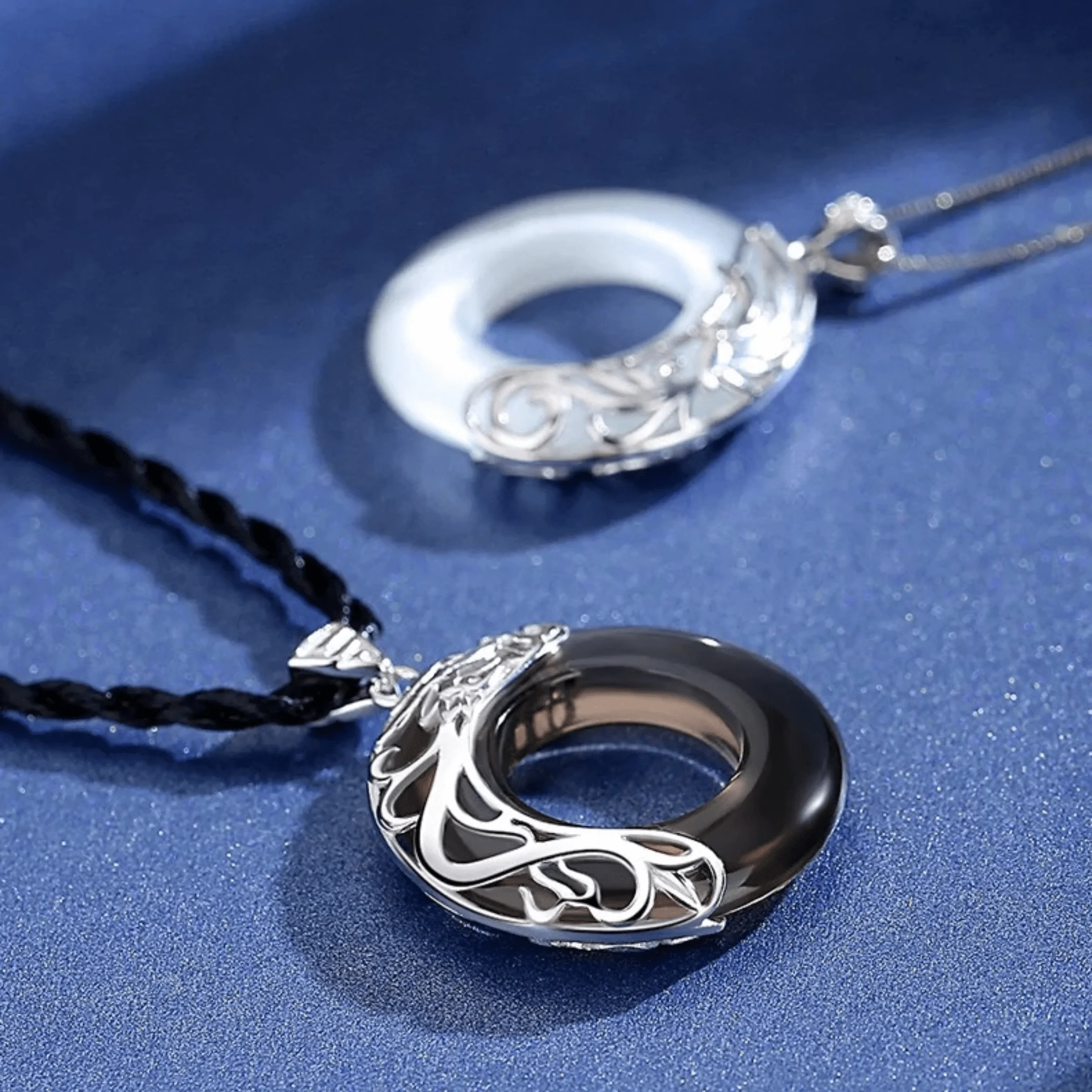
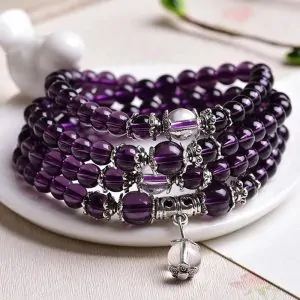
Material objects: In Taoist and Buddhist craft traditions, the objects we live with carry energetic qualities. A mala bracelet worn daily is both yin, the stone’s cool weight, the stillness of its surface, and yang, the intention held in each bead, the warmth of skin contact. The balance is worn, not merely thought.
→ Amethyst & Rose Quartz Mala, complementary energies in a single piece
→ Golden Sheen Obsidian Mala, light within darkness
Frequently Asked Questions About Yin and Yang
Is yin negative and yang positive?
No, this is the most common Western misreading. Yin and yang are not moral categories. Yin is not “bad” and yang is not “good”. Both are necessary; neither is superior. The concept describes relationship, not ranking.
What does the dot in the yin yang symbol mean?
The small circle of opposite colour inside each half represents the seed principle: yin contains the potential for yang, and yang contains the potential for yin. No state is permanent or absolute. Everything moves.
Where does the yin yang symbol come from exactly?
The taijitu in its current circular form was developed by Song dynasty philosopher Zhou Dunyi (1017–1073 CE), who described it in his Taijitu shuo. The underlying concept, broken and unbroken lines representing opposite forces, traces to the I Ching, which dates to the 9th century BCE or earlier.
Is yin yang Buddhist or Taoist?
It originates in classical Chinese cosmological philosophy, most closely associated with Taoism and the Confucian tradition. It was later integrated into certain forms of Chinese Buddhism but is not part of Buddhist doctrine itself.
Can yin and yang be applied to people?
In Chinese constitutional medicine, yes. Every person carries a mix of yin and yang tendencies, in their body type, temperament, and seasonal rhythms. Understanding your own yin-yang pattern is a starting point for personalised care in TCM.
We have studied and sourced handcrafted Asian objects for over a decade. The philosophy of yin and yang shapes how we think about our collection, the balance between beauty and function, tradition and daily life, the quiet and the alive.
Explore the Sanctuary collection →
You might also like
These ancestral tools for daily practice are available in our collection.
Get our Sanctuary Blueprint — free practice guide
Get the Sanctuary Blueprint — free
Five practices, one object, one anchor. Download the Blueprint.
The Ba Gua — the eight Taoist trigrams — is the oldest visual representation of the yin and yang polarity mapped across eight directional forces. If you want to carry this principle as a daily object : Ba Gua Eight Trigrams Pendant in Solid Silver S925.
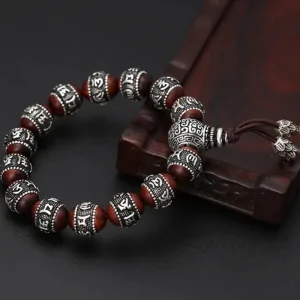
Black agate has been associated with the yin force in Chinese and Tibetan tradition for centuries. The dark stone absorbs and grounds. It is the counterpart to the lighter stones worn for clarity and expansion : Black Agate Mala Bracelet — Om Mani Padme Hum.