


🇫🇷 Vous préférez lire cet article en français ? Cliquez ici :
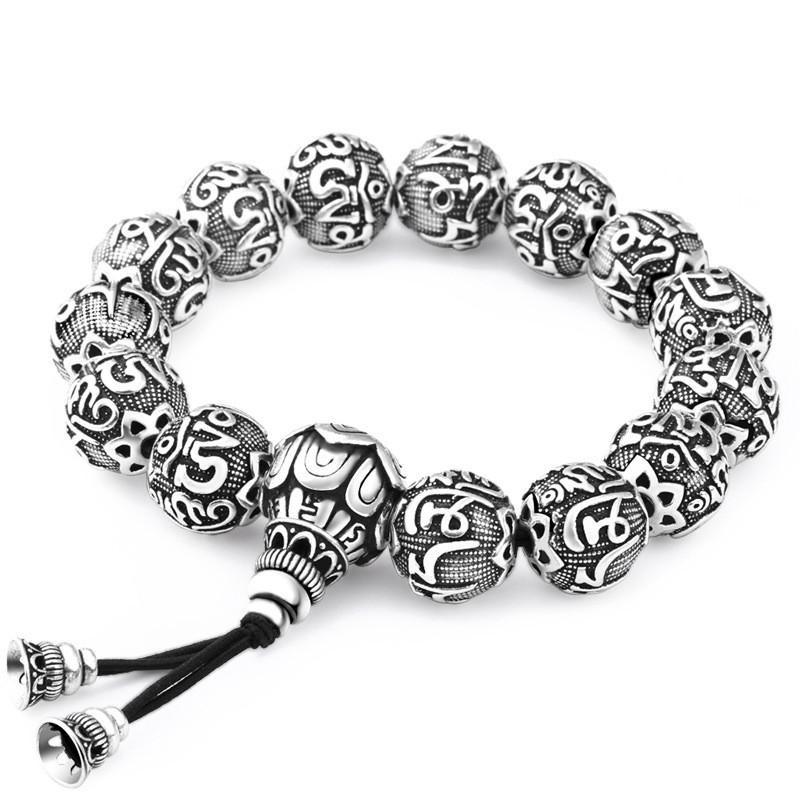
A mantra engraved on a Tibetan mala. The same mantra, rendered differently on a Nepalese statue. Why do these variations exist? The answer lies at the crossroads of trade routes, pilgrimages, and spiritual traditions that shaped Asia for more than two millennia.
Mantras are not only sound formulas. They carry scripts, visual aesthetics, and a collective memory that transcends linguistic and geographic borders.
Sanskrit, the spiritual lingua franca of ancient Asia
Sanskrit belongs to the Indo-European language family and is one of the oldest documented languages in the world. Its spread across Asia took place over several millennia, carried by trade, migration, and above all by the expansion of Hindu and Buddhist traditions.
From Antiquity onward, routes linking the Caspian Sea, Central Asia, the Indian subcontinent, China, and Southeast Asia enabled not only the circulation of goods, but also of sacred texts, philosophical concepts, and ritual practices. Sanskrit thus became the reference language for religious teachings and rituals far beyond its original linguistic homeland.
This transmission was not imposed. It was adopted voluntarily. Buddhist and Hindu communities chose to preserve certain terms in Sanskrit, believing that translation could weaken their spiritual potency.

Encounter with local languages
As Sanskrit spread, it encountered long-established language families: Sino-Tibetan languages on the Tibetan Plateau and in China, Tai languages in mainland Southeast Asia, and Austronesian languages across island archipelagos.
These languages do not derive from Sanskrit, yet they absorbed large amounts of its religious and philosophical vocabulary. Mantras, in particular, were often preserved in their original Sanskrit form, even when surrounding texts were translated. This created a unique linguistic situation: communities spoke their local language while continuing to use Sanskrit ritual formulas, transcribed in different scripts according to regional traditions.
Sacred scripts: a complex evolution
Devanagari: the modern standard
Devanagari is today the standard script for Sanskrit in academic, editorial, and educational contexts. Recognizable by the continuous horizontal line running across the tops of letters, it prioritizes clarity and readability.
Although ideal for teaching and reading, it is rarely found on ancient ritual objects. Its function is primarily practical rather than symbolic, which explains its limited presence in ceremonial contexts.

Ranjana: Nepalese origins
Ranjana is a script developed in the Kathmandu Valley of Nepal, derived from ancient Brahmi scripts. It forms the historical foundation of Himalayan ritual scripts and remains in use in Nepal for certain religious and cultural texts.
Although often confused with Lantsa, Ranjana is in fact a distinct script, despite their shared origins. Ranjana served as the starting point for the development of more specialized Buddhist ritual scripts.

Lantsa: the quintessential Buddhist ritual script
In the 11th century, as Buddhism became firmly established in Tibet, Lantsa developed from Nepalese Ranjana to become the dominant ritual script of Himalayan Buddhist tradition.
Unlike Devanagari and even Ranjana, from which it derives, Lantsa prioritizes sacred aesthetics over readability. Its compact, ornamental, and sometimes nearly abstract forms make it the preferred script for mantras engraved on malas, prayer wheels, statues, and stupas.
Lantsa is not merely a writing system. It is regarded as inherently spiritually potent. Every stroke and curve contributes to the transmission of blessings. Across Tibet, Nepal, Bhutan, and the Himalayan regions, it is the ritual script par excellence, transforming ordinary objects into supports for spiritual practice.

Vartu: a complementary script
Alongside Lantsa, Vartu forms the second pillar of Buddhist ritual scripts. Developed in parallel from the same Brahmi roots, Vartu exhibits distinct characteristics:
- More angular and geometric forms than Lantsa
- A more condensed visual structure
- Specific use in certain ritual text types
- Harmonious coexistence with Lantsa in Tibetan monasteries

Together, Lantsa and Vartu became the primary vehicles of Buddhist textual tradition, acting as a unifying force for monastic communities while also serving as distinct identity markers within mantras and sacred texts.
Tibetan script (Uchen): adaptation and preservation
When Buddhism was introduced to Tibet in the 7th century, a new script was developed to transcribe the Tibetan language and translate Sanskrit texts. Uchen, the formal calligraphic style, became the script of religious texts, sutras, and monastic education.
More structured and less ornamental than Lantsa, it coexists harmoniously with it: Uchen for extended texts and teaching, Lantsa and Vartu for sacred mantras and ritual objects. This complementarity illustrates the richness of Tibetan Buddhist written traditions.

Monastic variations: local adaptations
In certain monasteries and traditional centers, translators and calligraphers developed their own variants of Lantsa and Vartu. These adaptations were used to transcribe Tibetan commentaries and enrich the literary output of sacred sites.
Such monastic variations explain why the same mantra may display subtle stylistic differences depending on its precise geographic origin. Each major monastery maintained its own master calligraphers, whose distinctive styles were passed down through generations.
Kutaksyar: mantras as monograms
A particularly condensed form of mantra deserves special attention: Kutaksyar. These are popular Buddhist mantras written as monograms, with all characters interwoven into a single highly stylized symbol.
These monograms are especially valued for cylindrical pendants (gau), wearable amulets, ritual seals, and engravings on small precious objects. Kutaksyar represents the culmination of sacred calligraphic art: a form where readability nearly disappears in favor of symbolic power and meditative aesthetics.

One mantra, many faces
The mantra Om Mani Padme Hum may appear in very different visual forms depending on context: in Devanagari in academic manuals, in Ranjana in Nepalese texts, in Lantsa on ancient malas, in Vartu within specific ritual texts, in Uchen in Tibetan monastic manuscripts, in Kutaksyar on amulets, or in workshop-specific stylizations.
This diversity is neither inconsistency nor error. It reflects centuries of cultural transmission, local adaptation, and spiritual continuity. The sound, intention, and meaning of the mantra remain unchanged; only the visual form varies according to tradition, usage, and geography.
Our prayer wheels, pendants, and malas embody this diversity: some bear mantras in traditional Lantsa, others in Tibetan Uchen, while some combine multiple scripts on a single object. Each variation tells a different story of transmission and cultural adaptation.
This graphic diversity also reflects a profound understanding of the sacred: writing is not merely communication, but a support for meditation, an object of veneration, and a conduit of blessings.

A rare expertise
Today, only a handful of people worldwide truly master the reading and writing of Lantsa and Vartu. Even fewer possess expert knowledge of Bon Smar scripts or the various Zhang-zhung script traditions.
This rarity makes authentically calligraphed objects all the more precious. Each piece represents not only artisanal craftsmanship, but also the preservation of endangered knowledge.
For those wishing to deepen their understanding of these complex scripts, specialized resources exist, notably the reference site Lantsha-Vartu, which documents these sacred writing systems and their variations in detail.
Ritual objects and cultural memory
Malas, statues, incense burners, and other ritual objects are not mere accessories of spiritual practice. They are material witnesses to an interconnected world where languages traveled with caravans, religions crossed political borders, and scripts themselves became sacred forms.
Wearing a mala engraved with a Lantsa mantra is carrying a living memory shaped by Silk Road exchanges, Himalayan pilgrimages, and spiritual transmissions that defined Asian cultural history.
Each calligraphic stroke, each curve of a Lantsa or Vartu character carries centuries of monastic meditation, master-disciple transmission, and spiritual devotion. These objects are bridges between past and present, ancient India and the contemporary Himalayas, sacred text and daily practice.
Our commitment at Artisan d’Asie
We collaborate with workshops that perpetuate these ancestral traditions with respect for form, materials, and craftsmanship. Every script, engraving, and stylistic variation tells a story far greater than the object itself.
Our collection of engraved mantras reflects this diversity: prayer wheels adorned with Lantsa on aged silver, cylindrical pendants bearing mantras in classical Tibetan script, malas whose beads are finely carved, and bracelets where sacred scripts intertwine with traditional motifs.

Understanding these scripts and their historical context allows spiritual objects to be appreciated with greater depth and accuracy. It recognizes that a mala or statue is not merely an aesthetic artifact, but a convergence of history, geography, linguistics, and spirituality.
By choosing authentic objects bearing these traditional scripts, you participate in preserving a living cultural heritage and supporting artisans who keep these rare skills alive.

Each piece in our collection bears witness to this continuity: the hands engraving Lantsa today repeat gestures passed down since the 11th century, directly linking contemporary practice to the monks who shaped these sacred forms in Himalayan monasteries a thousand years ago.
0 commentaire